DEXPI XML
Overview
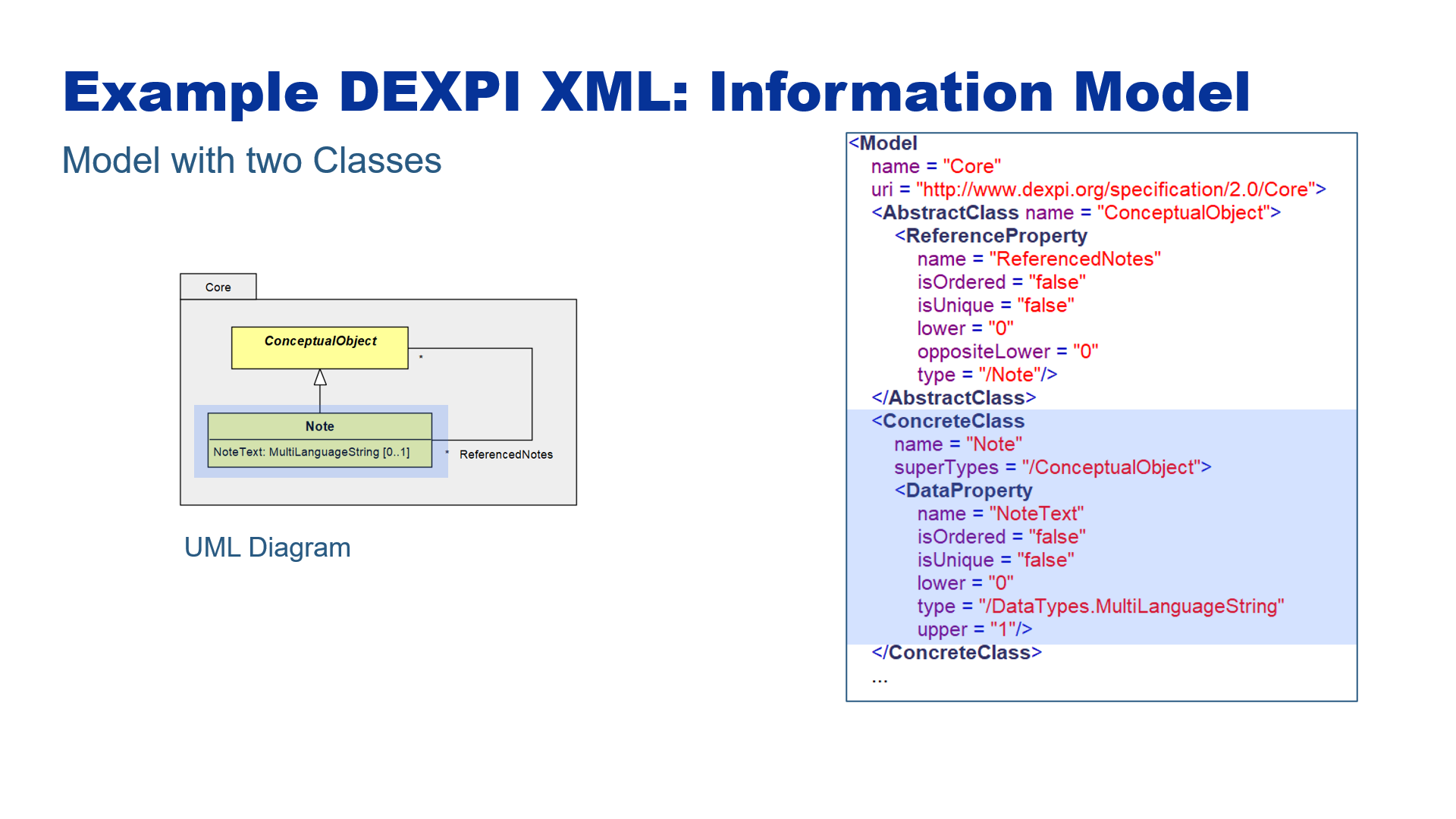
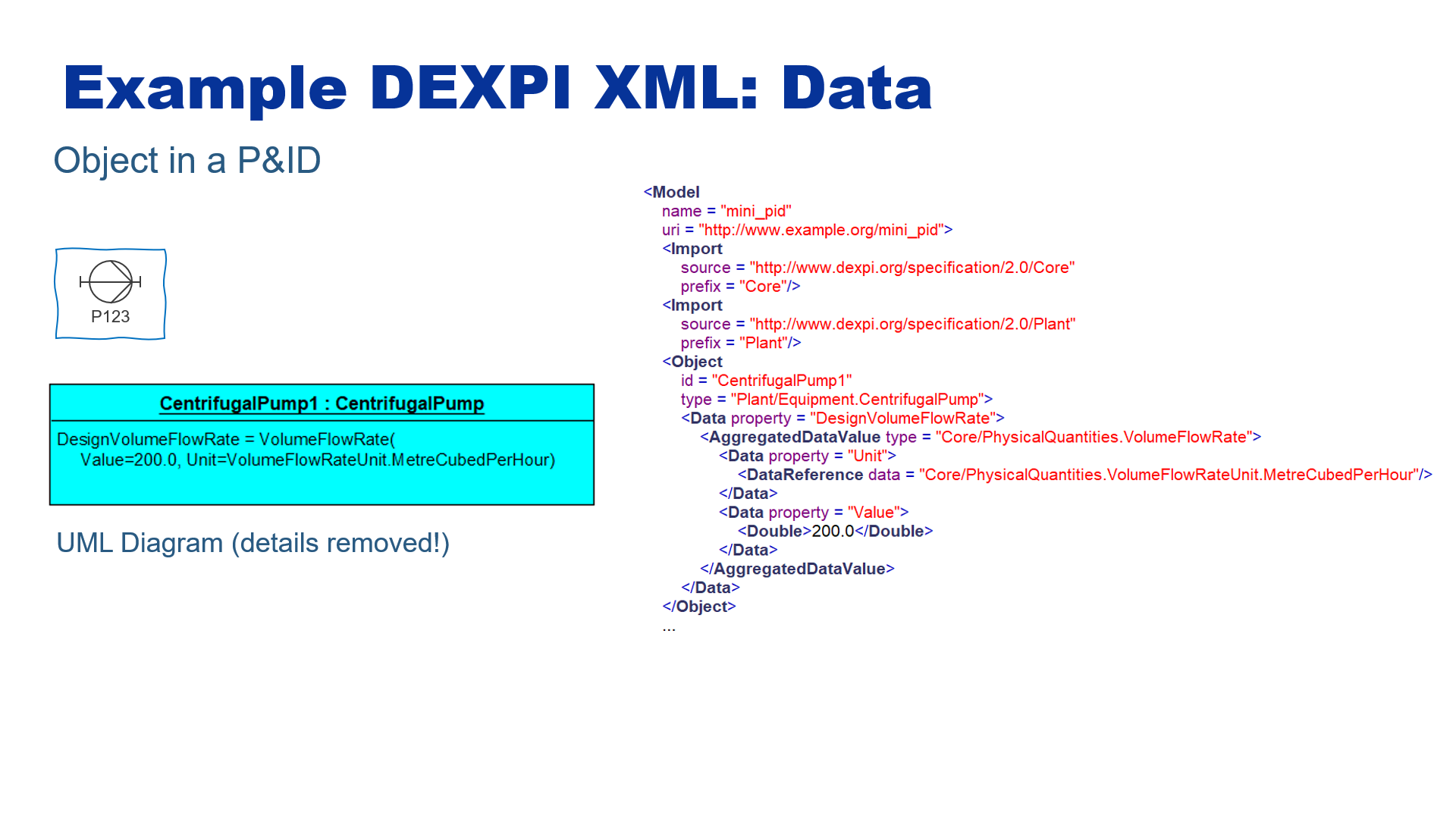
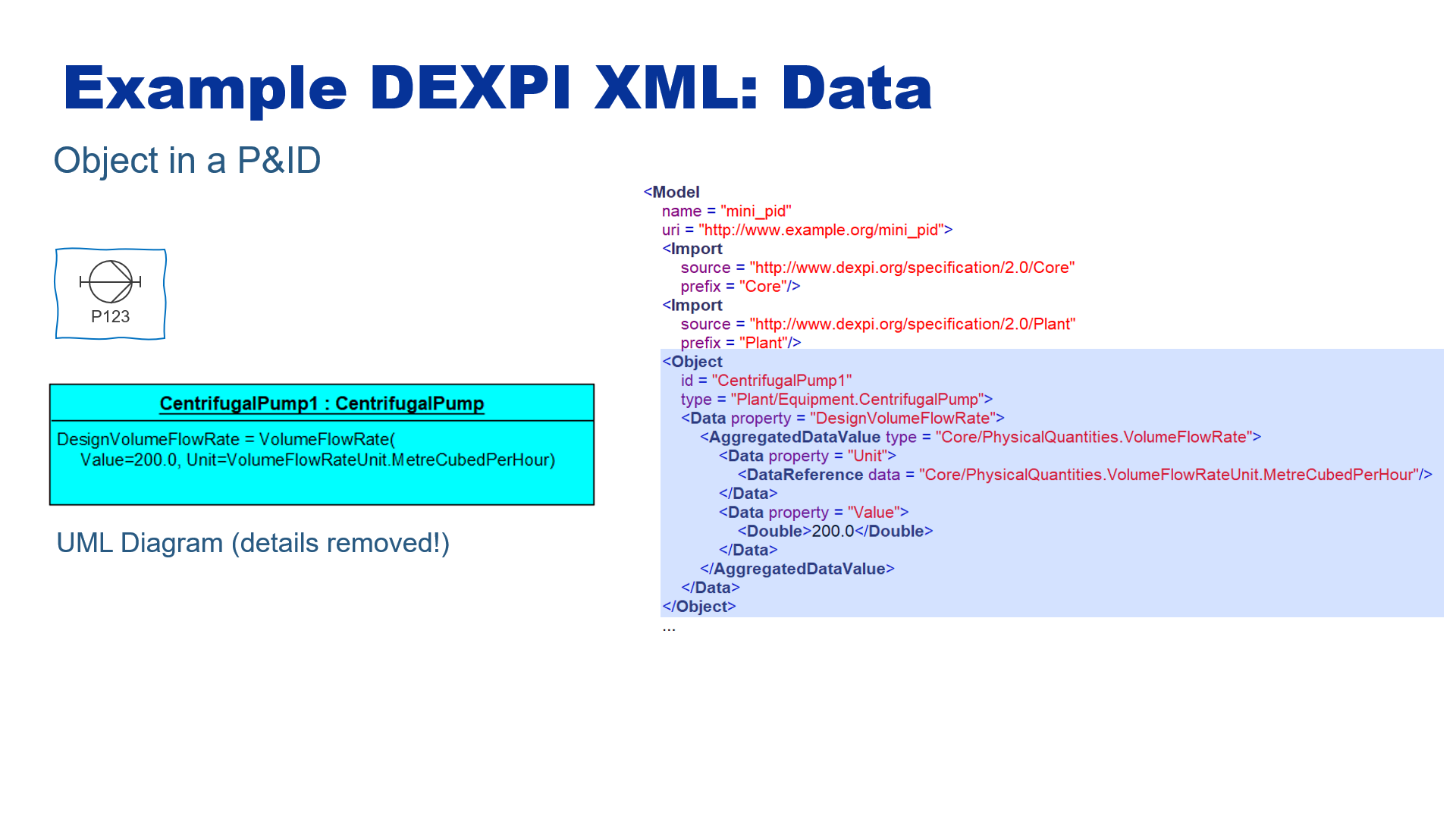
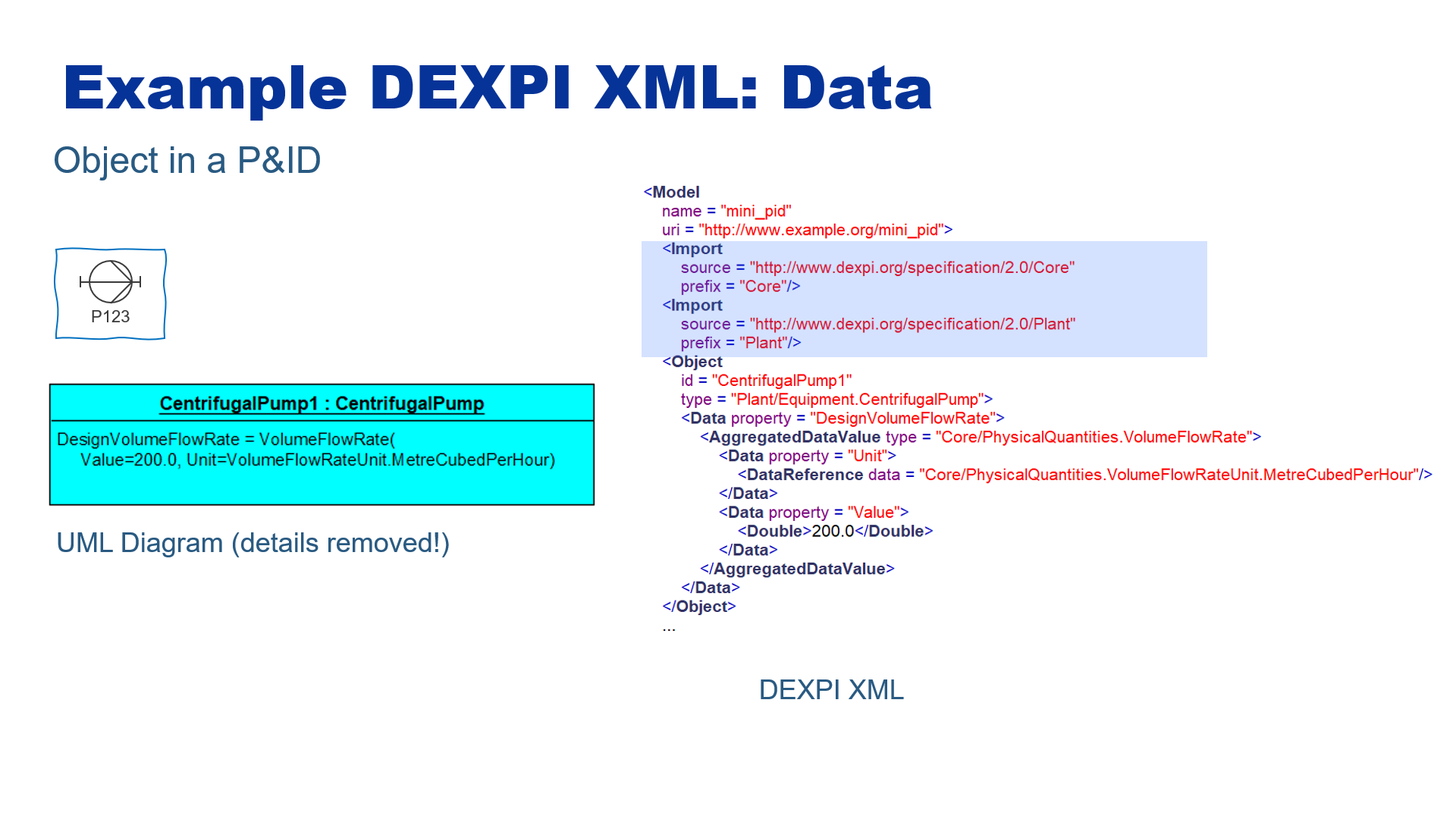
DEXPI XML Schema
Download DEXPI_XML_Schema.xsd.
There is also a generated XML Schema documentation.
Several DEXPI XML files are provided. See
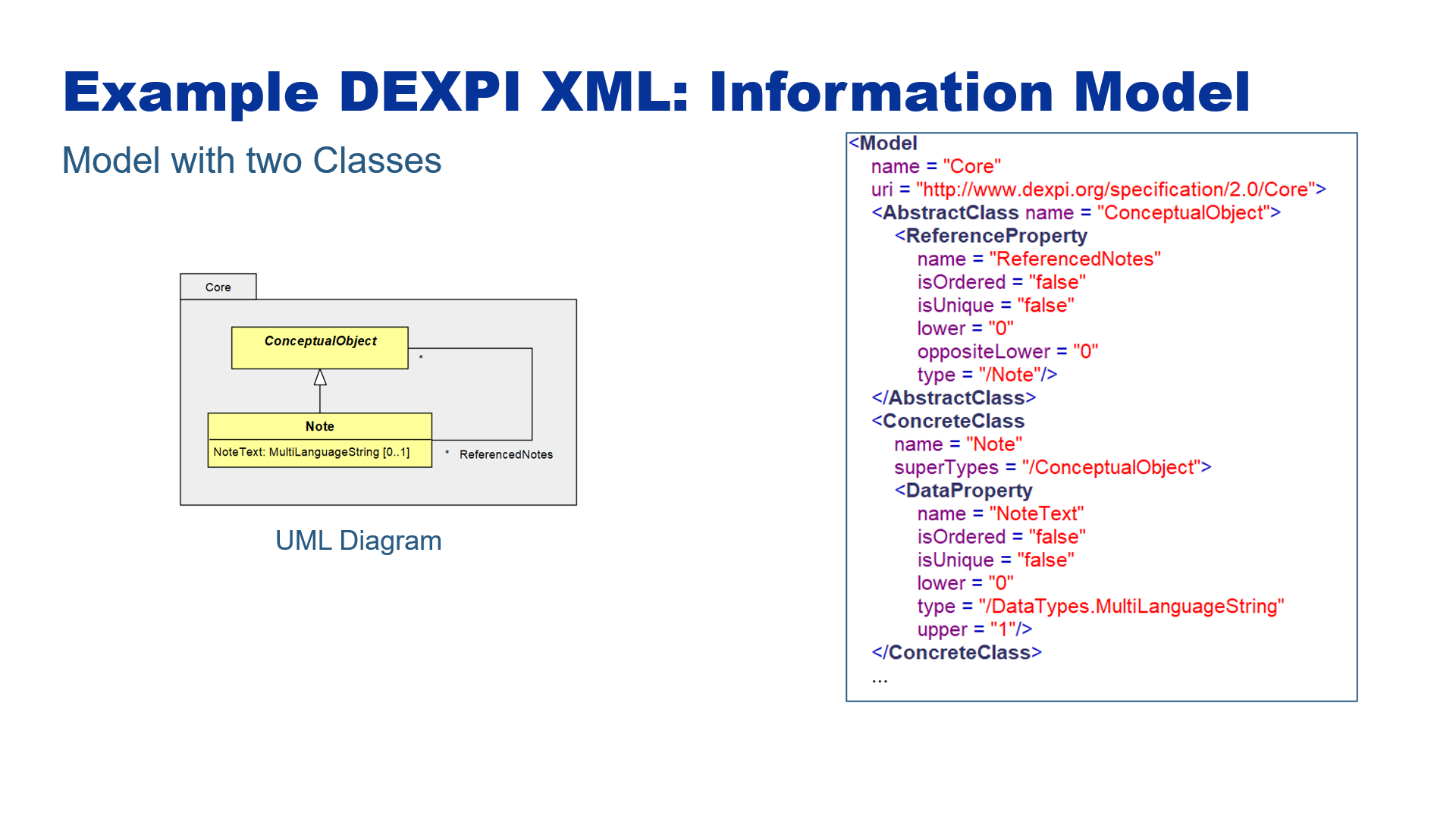
The root element of a DEXPI XML file has the name Model. Its complex type is Model.
Simple Types
ID
An ID is an xsd:string with the same restrictions as a name. In addition, an ID must be unique in a DEXPI XML file.
IDREF
An IDREF is a reference to an ID in the same file. It starts with a number sign (“hash”, #) that is immediately followed by the referenced ID.
name
A name is an xsd:string that
starts with an underscore (
_) or an upper (A-Z) or lower case (a-z) letter (ASCII only).The start character may be followed by an arbitrary number of underscores, upper or lower case letters, or digits (
0-9) in an arbitrary order.
nameOrIdReference
A nameOrIdReference is either a nameReference or an IDREF.
nameOrIdReferences
A nameOrIdReferences contains one or more nameOrIdReference parts, separated by a space character.
nameReference
A nameReference is a reference to a name in an arbitrary DEXPI XML file. It is composed of
a reference to a DEXPI XML file. This is either the
prefixof an imported file (see complex typeImport) or the empty string if it refers to the current file (i.e., the file that contains thenameReference);a slash character (
/);a
name. Thisnamerefers to the child element of the XML file’sModelelement with thatname.
Optionally, the nameReference may contain further names, each separated by a dot (.), in order to refer to further, nested elements.
Complex Types
AbstractDataType
An abstract data type. An abstract data type is the only admissible supertype for any data type.
Attributes:
name: the name of the abstract data type
superTypes: the supertypes of the abstract data type; only other abstract data types are allowed
AggregatedDataType
An aggregated data type.
Attributes:
name: the name of the aggregated data type
superTypes: the supertypes of the aggregated data type; only abstract data types are allowed
Children:
DataProperty*: the data properties declared for the aggregated data type
AggregatedDataValue
A value (“instance”) of an AggregatedDataType.
Attributes:
type: the type of the
AggregatedDataValue, i.e., anAggregatedDataType
Children:
Data*: the instance’s values for the data properties declared for the
AggregatedDataType
BooleanType
A primitive type, corresponding to xsd:boolean.
Attributes:
name: the name of the type
superTypes: the supertypes of the type; only abstract data types are allowed
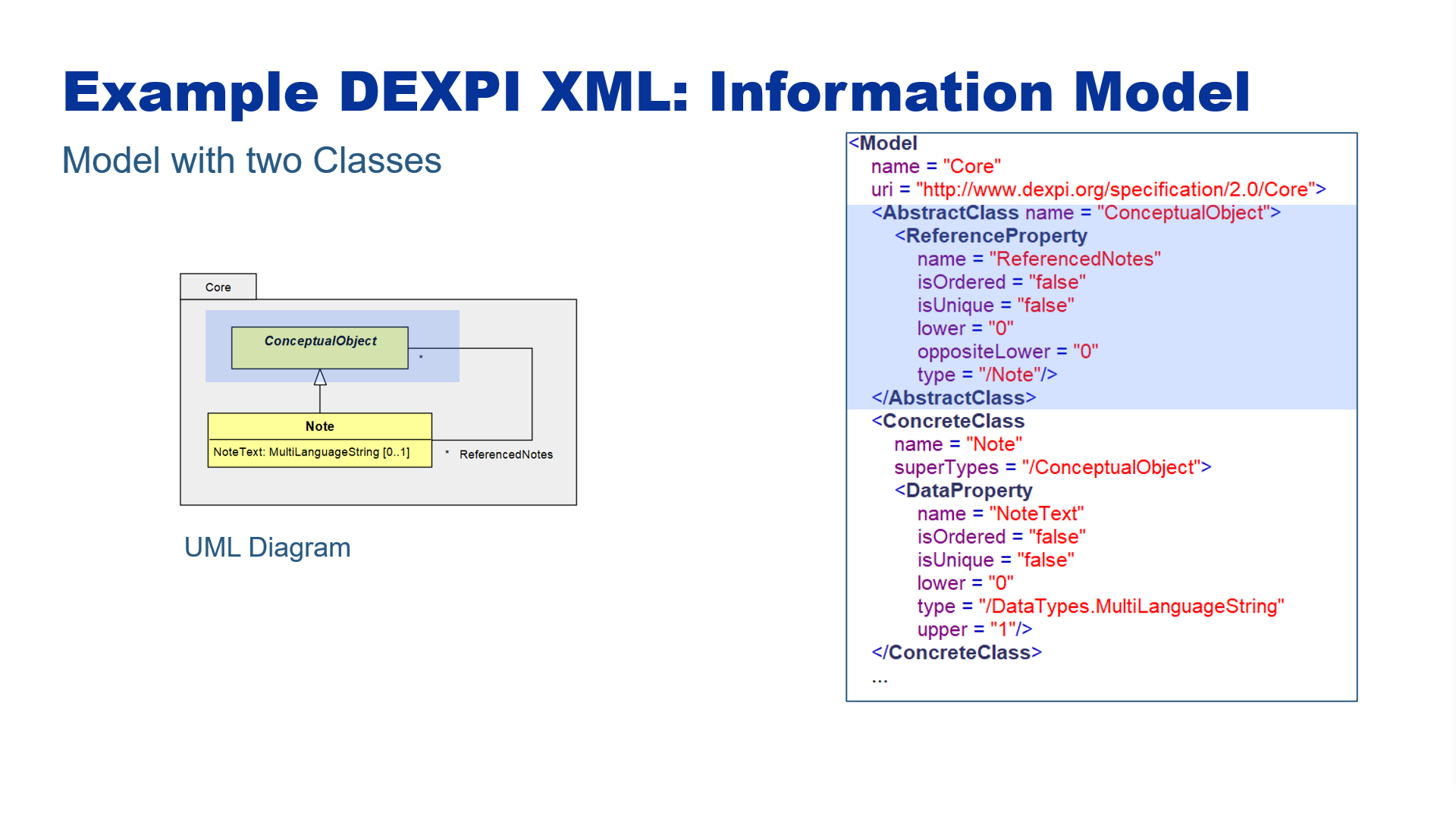
AbstractClass
An abstract class.
Attributes:
name: the name of the class
Children:
(CompositionProperty | DataProperty | ReferenceProperty)*: the properties declared for the class
ClassExtension
An extension of a class that can be used to “inject” additional properties.
Attributes:
baseType: a reference to the class that is extended
name: the name of the class extension
Children:
(CompositionProperty | DataProperty | ReferenceProperty)*: the properties declared for the class extension
Components
The values for a composition property for an object.
property: the name of the property
Children:
(Object | ObjectReference)+: the values for the property; if the property is ordered, the order of the values is relevant
CompositionProperty
A composition property, i.e., a property whose type must be a class and which indicates a composition (as opposed to a simple reference, cf. ReferenceProperty).
Attributes:
isOrdered: whether the property is ordered, i.e., whether the order of values is relevant
lower: lower multiplicity bound
name: the name of the property
type: the type of the property; must be a class
upper: upper multiplicity bound
ConcreteClass
An concrete (non-abstract) class.
Attributes:
name: the name of the class
Children:
(CompositionProperty | DataProperty | ReferenceProperty)*: the properties declared for the class
Data
The values for a data property for an object or aggregated data type.
property: the name of the property
Children:
(AggregatedDataValue | DataReference | Boolean | DateTime | Double | Integer | String)+: the values for the property; if the property is ordered, the order of the values is relevant
DataProperty
A data property, i.e., a property whose type must be a data type.
Attributes:
isOrdered: whether the property is ordered, i.e., whether the order of values is relevant
isUnique: whether the property is unique, i.e., whether a value can appear multiple times (only relevant is upper is greater than 1)
lower: lower multiplicity bound
name: the name of the property
type: the type of the property; must be a class
upper: upper multiplicity bound
DataReference
A reference to a data value defined elsewhere.
This is used to refer to a SingletonValue or an EnumerationLiteral.
Attributes:
data: the referenced data value
DateTimeType
A primitive type, corresponding to xsd:dateTime.
Attributes:
name: the name of the type
superTypes: the supertypes of the type; only abstract data types are allowed
DoubleType
A primitive type, corresponding to xsd:double.
Attributes:
name: the name of the type
superTypes: the supertypes of the type; only abstract data types are allowed
Enumeration
An enumeration.
Attributes:
name: the name of the enumeration
superTypes: the supertypes of the enumeration; only abstract data types are allowed
Children:
EnumerationLiteral*: the literals of the enumeration
EnumerationLiteral
An enumeration literal.
Attributes:
name: the name of the enumeration literal
Import
An import of a model by another model.
Attributes:
prefix: a simple string to be used to refer to the imported model (in order to avoid the potentially complex uri)
source: the uri of the imported model
IntegerType
A primitive type, corresponding to xsd:integer.
Attributes:
name: the name of the type
superTypes: the supertypes of the type; only abstract data types are allowed
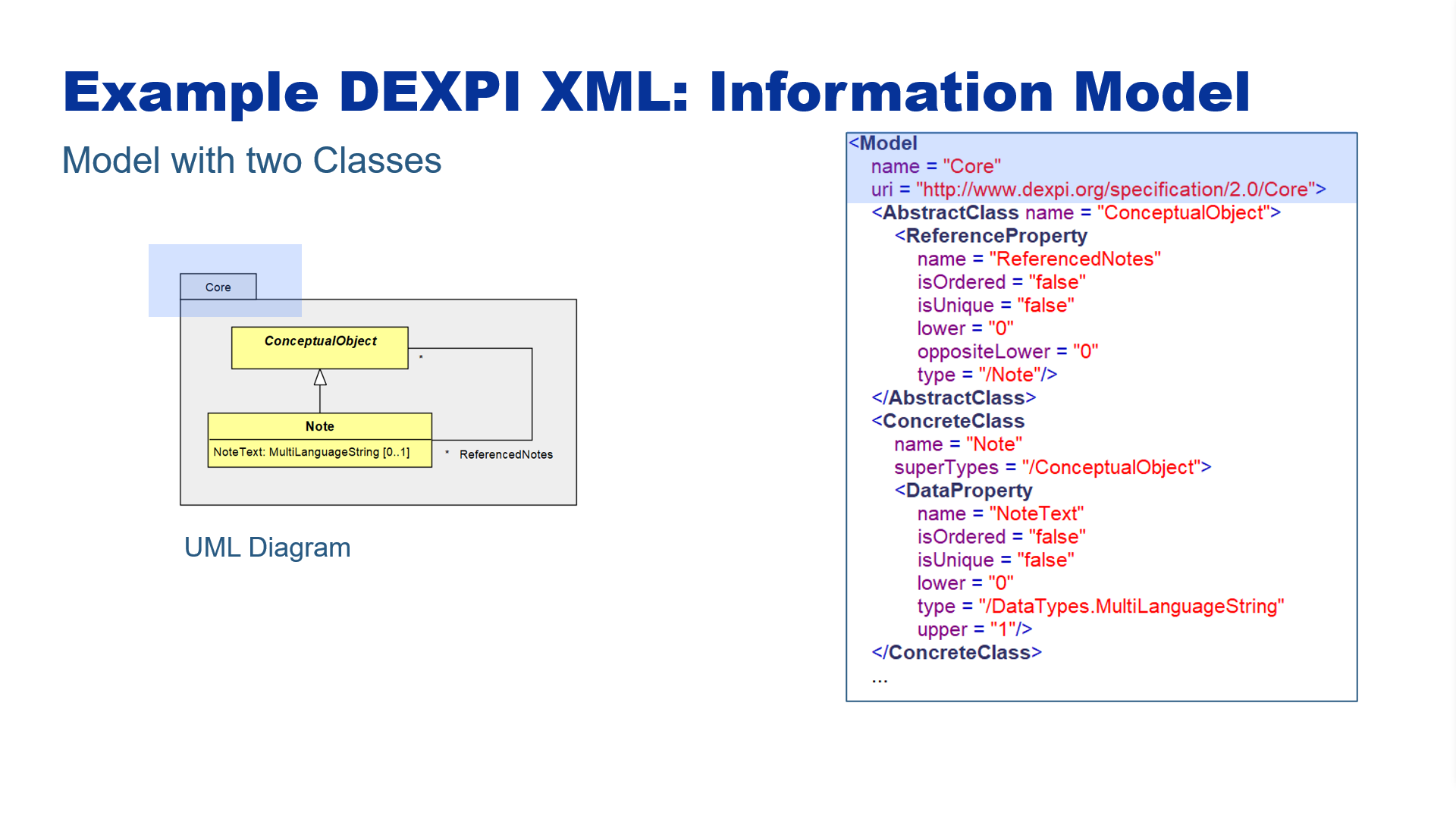
Model
A model. A model is a top-level package that corresponds to a DEXPI XML file.
Attributes:
name: the name of the model
uri: a unique identifier for the model
Children:
Import*: imports of other models that are referenced by the model
(Package | AbstractClass | ConcreteClass | AbstractDataType | AggregatedDataType | Enumeration | SingletonType | SingletonValue | BooleanType | DateTimeType | DoubleType | IntegerType | StringType | Object)*: the content of the package
Object
A value (“instance”) of a Class.
Attributes:
id: optional; an identifier for the object to be used for references within the same DEXPI XML file
name: optional: a name for the object to be used for references, also from other files
type: the type of the object, i.e., a class
Children:
(Components | Data | References)*: the instance’s values for the properties declared for the
Class
ObjectReference
A reference to an object.
Attributes:
object: the actual reference
Package
A package.
Attributes:
name: the name of the package
Children:
(Package | AbstractClass | ConcreteClass | AbstractDataType | AggregatedDataType | Enumeration | SingletonType | SingletonValue | BooleanType | DateTimeType | DoubleType | IntegerType | StringType | Object)*: the content of the package
ReferenceProperty
A reference property, i.e., a property whose type must be a class and which indicates a simple reference (as opposed to a composition, cf. CompositionProperty).
Attributes:
isOrdered: whether the property is ordered, i.e., whether the order of values is relevant
isUnique: whether the property is unique, i.e., whether a value can appear multiple times (only relevant is upper is greater than 1)
lower: lower multiplicity bound
name: the name of the property
oppositeLower: the opposite lower multiplicity bound
oppositeUpper: the opposite upper multiplicity bound
type: the type of the property; must be a class
upper: upper multiplicity bound
References
The values for a reference property for an object.
property: the name of the property
objects: references to the values
SingletonType
A singleton data type, i.e., a type that as a single value (“instance”).
Attributes:
name: the name of the type
superTypes: the supertypes of the type; only abstract data types are allowed
SingletonValue
The value of a singleton type.
Attributes:
name: the name of the value
type: the singleton type
StringType
A primitive type, corresponding to xsd:string.
Attributes:
name: the name of the type
superTypes: the supertypes of the type; only abstract data types are allowed