

Conference Recap: DEXPI at Radix RUSH EMEA 2026
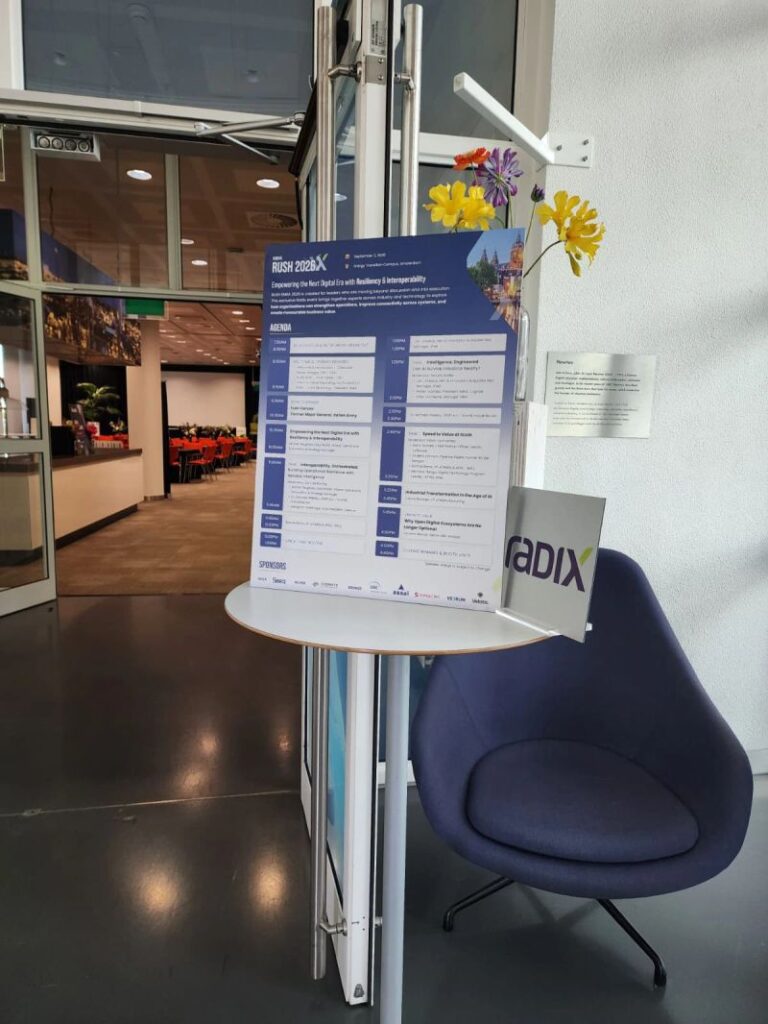
On September 2, 2026, Radix RUSH EMEA took place at the Energy Transition Campus Amsterdam, bringing together industry stakeholders to discuss interoperability, industrial resilience, and AI-ready data architectures.
A central contribution came from Dr. Michael Wiedau (DEXPI / Evonik), who presented „From Interoperability to Intelligence: AI-Ready Engineering Data with DEXPI“. The presentation outlined how machine-readable P&IDs and semantic data structures can support graph-based evaluations and AI-related engineering scenarios, including flowsheet completion and HAZOP-oriented analysis. These examples were positioned as research- and development-oriented perspectives, without implying production readiness.
Dr. Wiedau also participated in the panel discussion „Interoperability, Orchestrated: Building Operational Resilience with Reliable Intelligence“, alongside Michel Teughels (ExxonMobil) and Meaghan Snethlage (VEERUM), moderated by John de Koning (Radix). The discussion addressed technical, organizational, and commercial barriers that continue to limit scalable interoperability across system boundaries and lifecycle phases.
For the DEXPI community, the event reinforced a clear message: semantic interoperability and open standards are increasingly recognized as prerequisites for reliable, cross-disciplinary engineering data and future AI-enabled industrial workflows. In this context, DEXPI’s collaborative, vendor-independent approach remains directly aligned with the practical requirements of data-driven engineering in the process industry.
DEXPI e.V. would like to thank Radix for the invitation and the excellent organization of the event, as well as all speakers and participants for the valuable exchange. Such formats make an important contribution to advancing interoperability, standardized data exchange, and cross-disciplinary dialogue across the process industry.




DEXPI at Future Digital Twin & AI Amsterdam 2026
DEXPI participated in Future Digital Twin & AI Amsterdam 2026, engaging with industry leaders, technology providers and asset owners exploring digital twins, AI and industrial interoperability. Representatives from DEXPI member companies, including Shell, Evonik, CADMATIC, Deeplify, Semantum and Siemens, contributed to a strong community presence at the event.
A key highlight was Michael Wiedau’s presentation on the DEXPI mission and the role of standardised engineering data in AI-enabled digital twins. Building on the event’s focus on practical digital twin and AI implementation, Michael explained why high-quality, interoperable engineering information is a prerequisite for moving from isolated digital initiatives to scalable, trusted industrial applications. He emphasised that DEXPI provides a vendor-neutral and machine-readable foundation for P&ID and process engineering data, helping organisations exchange information consistently across engineering tools, asset information systems and digital twin platforms.
Michael also connected the DEXPI mission to the broader need for implementable industrial use cases. His presentation highlighted how structured engineering data can support brownfield migration, handover, automation and AI-driven workflows by preserving the meaning, relationships and context of plant information. The session and discussions at the DEXPI booth generated strong interest in practical approaches to exchanging and using engineering information across systems and organisations.
The event’s mission closely aligns with DEXPI’s goal of enabling open, vendor-neutral and machine-readable engineering data. This foundation is very important for developing reliable digital twins and AI applications: structured, semantically rich information gives digital solutions the context needed to connect data, automate workflows and support informed decisions throughout the asset lifecycle.






DEXPI welcomes PNID.IO as a new member
DEXPI e.V. is pleased to welcome PNID.IO as a new member of the DEXPI community.
PNID.IO specializes in transforming static engineering documents into structured, interoperable data. Its AI-powered platform converts legacy P&IDs, PFDs, and other engineering documents into machine-readable, DEXPI-aligned data models that can be used across engineering, operations, maintenance, analytics, and asset management systems.
For PNID.IO, joining DEXPI is a natural step. The company sees standardized and connected engineering data as a key foundation for the next generation of process-industry software. A shared, interoperable format can reduce barriers between applications and enable engineering information to move more seamlessly across systems and workflows.
DEXPI, in turn, welcomes the practical perspective PNID.IO brings to the association. Its experience in extracting, structuring, and transferring data from existing engineering documents adds valuable expertise to the ongoing work on interoperability and digital engineering workflows.
We are pleased to have PNID.IO on board and look forward to advancing interoperable engineering data together!
DEXPI 2.0.1 Specification Published
We announced an update in August. Now it is here: DEXPI 2.0.1 officially replaces DEXPI 2.0 and is available as of today.
What has changed? The update specifically addresses findings from DEXPI 2.0: corrections to the Plant Model, a more systematic taxonomy of Process Steps in the Process Model, and an updated reference P&ID that accounts for the DEXPI 2 Nozzle classes. All changes are documented in the changelog directly within the specification.
DEXPI 2.0.1 is the result of close cross-disciplinary collaboration between the DEXPI Plant SIG, the DEXPI Process SIG, and the DEXPI Specification Steering Team — a testament to the industry-driven, collaborative approach that defines standardized data exchange under the DEXPI initiative.
The specification is published under the Creative Commons Attribution 4.0 International (CC BY 4.0) license and is freely accessible on GitLab. For all details, please visit: https://dexpi.org/dexpi-2-0-1-specification-published-the-update-replacing-dexpi-2-0/